A spy theme party can combine spy training with a cooperative mission built around observation, decoding, and movement. One documented observation game uses twelve ordinary objects. A printable Secret Agent treasure hunt is listed at $13.99, but the available information doesn’t establish a complete party package, overall budget, or guest-count totals.
- The printable Secret Agent treasure hunt costs $13.99 and is delivered instantly by email after ordering.
- The printable treasure hunt has ten clues and includes a cipher wheel and Morse decoder for each player.
- The observation game uses twelve safe, ordinary objects.
- The printable mystery detective game is described as suitable for ages 8–14 and includes ten challenges and five suspects.
What decorations, invitations, and activities belong in a spy theme party package?
A spy theme party can center on spy training and a cooperative mission, with activities built around observation, decoding, and movement. The available guidance describes activities, not a standard commercial package or typical decorations, so those details are unknown. For a spy theme party invitation, include the date, time, location, RSVP information, and whether guests need clothes suitable for movement.
Activity examples include writing an invisible-ink message with lemon juice and Q-tips, taking turns identifying an object by touch in a sensory box, and setting up a laser-style challenge using yarn and mini bells or streamers. A spy theme party can use these as separate training stations before the mission. The ledger doesn’t establish whether decorations, gadgets, or a particular set of supplies are normally included in a party package.
How do spy party packages differ for children, teens, and adults?
Available spy theme party age guidance describes adaptations for younger and older children, but doesn’t establish package differences for teens or adults. For younger children, the observation game uses six objects and leaves the tray visible so they can match objects to picture cards. For older children, the guide suggests removing one object between rounds.
A printable mystery detective game is described as suitable for ages 8–14 and includes ten challenges that lead players to identify which of five suspects is the culprit. That gives a host one age-specific activity option, not a full package recommendation. For a spy theme party, you can use the documented observation-game adjustment when planning for younger or older children. The ledger provides no specific teen-or-adult package recommendations, and it doesn’t describe separate options for those age groups.
What kind of activities can we do at a spy theme party?
Field Agent Training & Mission Activities
Keep junior detectives engaged from the moment they walk through the door with interactive challenges, puzzle-solving games, and energetic undercover field drills.
Preschool & Kindergarten (Ages 4–6)
These introductory spy missions focus on physical movement, colorful visual cues, and sensory exploration that require zero reading skills and keep frustration completely off the table.
- Footprint Tracking Trail: Cut distinct boot prints out of bright construction paper and tape them along the floor; little agents follow the path through the house to discover where the target went.
- Mystery Disguise Box: Cut two armholes into the side of a covered cardboard box and place quirky everyday objects inside (a squeaky toy, a pinecone, a soft brush); kids reach in blind and guess the spy gear using touch alone.
- Agent Identity Station: Set out washable stamp pads so kids can leave a thumbprint on a badge lanyard, choose a fun codename like “Agent Lightning,” and snap an instant camera mugshot.
- The Disguise Relay Race: Split players into two lines; each runner dashes to a dress-up trunk, puts on an oversized fedora, sunglasses, and a trench coat, strikes a dramatic spy pose, and dashes back to tag a teammate.
- The Quiet Infiltration Crawl: Lay a wide strip of bubble wrap across the living room floor; agents take off their shoes and challenge themselves to tiptoe across the strip without making a single pop sound.
- Disappearing Target Practice: Draw simple chalk bullseyes on a fence, brick wall, or patio; hand little detectives water squirt bottles and let them “erase the evidence” by washing the targets away.
- Agent Boot Camp Warm-Up: Lead a high-energy, five-minute training drill with silly undercover challenges: ten tiptoe ninja jumps, three silent rolls across a soft rug, and a ten-second stealth freeze.
- Stealth Flashlight Freeze: Dim the lights and sweep a slow-moving flashlight beam across the room while music plays; whenever the beam sweeps across the room, undercover agents instantly freeze in place.
- Lineup Photo Booth: Tape a paper height chart to a blank wall and hand kids mini chalkboards where they write or scribble their agent code name for an adorable rookie lineup photo.
- Secret Passcode Knock: Teach the group a simple, rhythmic knock (tap-tap-pause-tap) at the kitchen door before granting clearance to enter for cupcakes or juice.
- Official Agent Graduation: Play upbeat mission music and call up each recruit by their code name to receive a personalized certificate of completion and a pair of dark sunglasses.
Early Elementary (Ages 7–9)
Agents in this stage love hands-on gadgets, active target drills, simple scavenger hunts, and discovering hidden clues they can decode with friends.
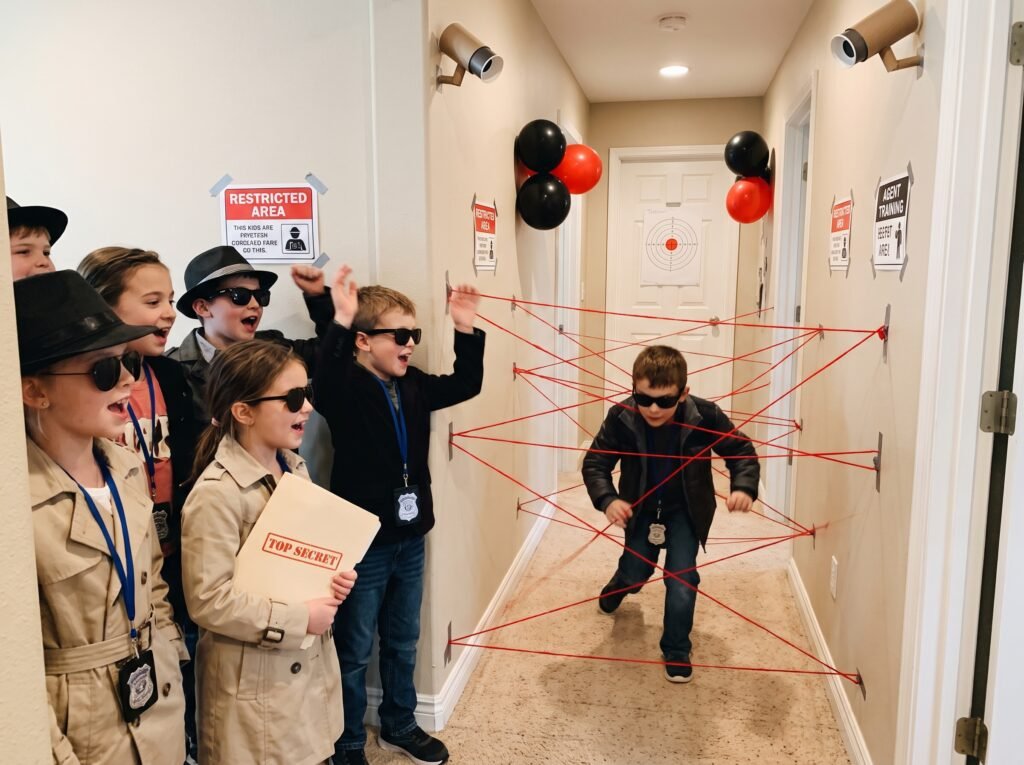
- Laser Maze Obstacle Run: Tape lengths of bright red yarn across a hallway at alternating knee and waist heights; tie small craft bells to a few center strands so players try to slip through without ringing an alarm.
- Invisible Ink Messages: Give kids white crayons to write secret notes or symbols on white cardstock; brushing over the paper with diluted watercolor paint instantly exposes the hidden message.
- Target Practice Nerf Range: Stack lightweight plastic cups decorated with printed villain logos across a folding table, letting recruits test their field accuracy using foam dart blasters.
- The Dead Drop Scavenger Hunt: Hide mini metal mint tins or waterproof canisters around the backyard, giving teams a hand-drawn treasure map to locate all the capsules and piece together the master clue.
- Agility Obstacle Course: Design a backyard obstacle run using cardboard box crawl-tunnels, hula-hoop tire runs, and a low wooden 2×4 balance beam to test undercover agility.
- Balloon Evidence Stomp: Tie a black balloon to each guest’s ankle with yarn; players protect their own classified balloon while trying to gently stomp and pop their fellow agents’ balloons.
- Forensic Chemistry Slime Lab: Combine clear school glue, baking soda, and saline solution with green food coloring and silver glitter so every scientist can mix and bag their own “classified sample.”
- Balloon Decryption Pop: Roll short clue words onto paper strips and slip them inside black balloons before blowing them up; kids pop the balloons by sitting on them, gathering the words to assemble a secret sentence.
- Lock & Key Scramble: Snap a brass padlock onto a locked prize trunk and scatter ten assorted keys across the room; players test each key until they hear the lock click open.
- Steal the Diamond: Place a large faux plastic jewel beneath an armchair where a blindfolded “security guard” sits; silent operatives take turns creeping up to snatch the gem without making a sound.
- Microdot Search: Place ten colored circle stickers in plain sight around the room; equip agents with magnifying glasses and a checklist to spot and verify all ten locations.
- Voice Pitch Masquerade: Use a free voice-changer tablet app to record each agent speaking a one-sentence clue, then play the modified recordings back for the room to guess the speaker.
Tweens & Teens (Ages 10 & Up)
Older operatives thrive on genuine problem-solving, strategic communication, deduction games, and escaped-room-style locks that reward quick thinking.
- Safe-Cracking Lockbox Challenge: Place party favors inside a three-dial combination lockbox, hiding three mini math, riddle, or visual clues around the room that together reveal the unlocking combination.
- Bomb Defusal Wire Snip: Construct a cardboard prop timer box rigged with red and blue yarn strands; the squad answers rapid-fire trivia questions about the guest of honor to deduce which wire is safe to cut.
- Surveillance Memory Test: Arrange twelve distinct spy gadgets (pocket compass, keychain light, padlock, sunglasses) on a silver tray; give players thirty seconds to memorize the items before covering the tray and challenging them to write down all twelve.
- Forensic Fingerprint Lifting: Have guests rub a heavy graphite patch onto scrap paper with a pencil, press their fingertip in the dust, lift the print using clear packing tape, and mount it to an index card for analysis.
- Lie Detector Party Game: Have an adult run a mock polygraph while asking players rapid-fire, absurd questions to see who can answer with a completely straight face without laughing or looking away.
- Cipher Wheel Decoding: Assemble two-tier rotating cardboard cipher wheels fastened with a center brad; operatives shift the alphabet by a set number of spaces to translate encoded encrypted sentences.
- Spot the Mole: Seat the squad in a circle and secretly tap one player to be the undercover mole; the mole discreetly winks at other players to “take them out of commission” while the group tries to unmask the traitor.
- Walkie-Talkie Blind Navigation: Put one agent in a blindfold in a room with soft pillow obstacles while their partner stands in another room, guiding them across the safe zone purely through walkie-talkie directions.
- Mastermind Logic Grid: Hand out a custom elimination logic puzzle where agents read four connected clues to figure out which suspect stole which gadget at what time.
- Paper Handcuff Escape: Interlink two players using paper chain loops around their wrists; partners must twist, turn, and step over the loops to free themselves without breaking the paper.
- Word Tile Decryption: Hide wooden Scrabble or craft letter tiles throughout the party space; once gathered, the team must rearrange the letters to solve an anagram that reveals the location of the party loot.
- Operation Cake Retrieval: Design an escape-room grand finale where the completed clues, cipher wheels, and decrypted codes from earlier games combine to unlock the pantry door holding the birthday cake.
How much does it cost to host a spy-themed party for 10, 20, or 30 guests?
The only listed price for a spy theme party activity is $13.99 for a printable Secret Agent treasure hunt, delivered instantly by email after ordering. That is the price of the listed printable, not a complete party budget.
The ledger gives no total cost for hosting 10, 20, or 30 guests. It also doesn’t provide prices for food, decorations, entertainment, or most activity supplies, so a per-person estimate can’t be calculated from the available information. A host planning a spy theme party should treat the $13.99 figure as one optional activity cost only. The sources don’t state whether other costs are included with that purchase, or what a complete event would cost at any guest count.
What supplies do I need for a spy-themed party at home, and how many should I buy?
A spy theme party at home can use activity-specific quantities, but the ledger doesn’t provide a complete shopping list or total quantities for groups of 10, 20, or 30. The printable treasure hunt contains ten clues and includes a cipher wheel and Morse decoder for each player. For fingerprint identification, use one index card per player, cut in half, with matching prints on each card.
A scytale clue can be made by wrapping a long strip of paper around a toilet-paper tube, writing the message, and unrolling the strip. A pretend bomb prop uses five paper-towel rolls or paint rolls. The observation game calls for twelve ordinary objects, while a decoding activity uses a key with six shapes representing six letters. These counts cover the described activities; they don’t determine all supplies needed for your spy theme party.
Secret Agent Party Decorations
Transforming your party space into an elite reconnaissance base doesn’t require high-tech gadgets—just clever styling with black, white, kraft paper, and pops of crimson red.
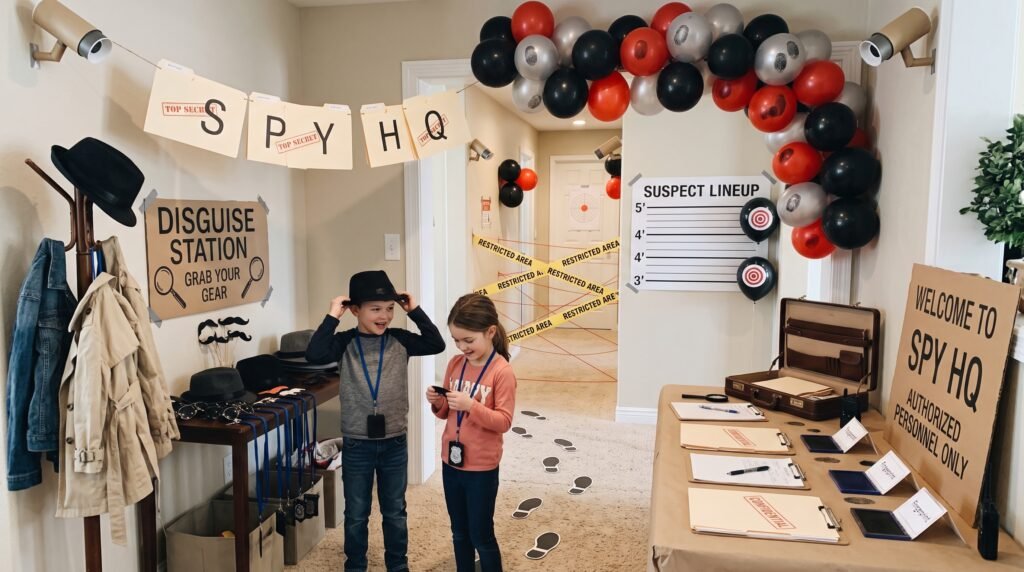
- Top Secret File Folder Banners: String classic manila folders stamped with red “TOP SECRET” ink across your mantel, entryway, or food table with simple baker’s twine.
- Red Yarn Laser Hallway: Tape lengths of crisscrossing red yarn at varying heights down your hallway to create an instant laser security corridor that kids love climbing through.
- Caution Tape Entryway: Crisscross bright yellow caution or “RESTRICTED AREA” tape across the front door so guests know they are entering active headquarters.
- Classified Kraft Paper Tablecloth: Cover your main food and craft tables in brown kraft paper, using black marker to draw redacted text boxes and red ink stamps across the surface.
- Silhouette Spy Cutouts: Cut trench coat, fedora, and magnifying glass silhouettes out of black cardstock and tape them inside your windows so they look like shadows lurking outside.
- Fingerprint Balloon Garland: Build an arch or table garland using matte black, crisp white, and silver balloons, stamping a few white balloons with oversized black ink thumbprints.
- Disguise Station Display: Set out a coat rack or hat stand near the entrance stocked with dark sunglasses, trench coats, fedoras, and stick-on mustaches.
- Authorized Personnel Welcome Sign: Place a framed chalkboard or printed sign at the porch reading: Welcome to Spy HQ: Authorized Personnel Only.
- Magnifying Glass Centerpieces: Fill simple glass jars with dark river rocks, small faux evidence tags, and a classic magnifying glass leaning casually against the rim.
- Chalk Body Outline Walkway: Use white sidewalk chalk or painter’s tape on your front path to outline a goofy secret agent silhouette pointing toward the front door.
- Code-Cracking Wall Mural: Hang black butcher paper along a blank wall and write out chalk math formulas, question marks, and binary code for an authentic lab feel.
- Monochrome Table Runners: Lay a black-and-white striped table runner down your main dining table to anchor sleek gadgets and bright party plates.
- Red Alert Porch Light: Swap your standard porch lightbulb for a red LED bulb so arriving guests immediately see the house bathed in “security alarm” red.
- Vintage Briefcase Favor Table: Prop open a thrifted or hard-shell briefcase on your welcome table to hold mission envelopes, party badges, and disguise kits.
- Microdot Confetti: Punch circles out of black, silver, and crimson cardstock with a standard hole puncher to sprinkle “microdots” across the tables.
- Stamped Manila Envelope Place Cards: Label mini manila envelopes with each child’s codename (e.g., “Agent Cooper”) and place them on their plates with a mini magnifying glass.
- Cardboard Security Cameras: Spray-paint disposable paper coffee cups matte black, add a small red dot of paint to the base, and mount them in ceiling corners as surveillance cameras.
- Two-Way Radio Accents: Place inexpensive toy walkie-talkies on risers between serving platters as thematic table accents.
- Laser Grid Fairy Lights: String affordable strands of red wire fairy lights horizontally across your living room ceiling for an ambient evening mission glow.
- Redacted Document Paper Chains: Cut strips of paper printed with black redaction bars and link them into modern, graphic paper chains.
- Restricted Access Door Signs: Hang printable signs marked “Restricted: Level 5 Clearance Required” on bedroom and office doors to keep little agents focused in the party rooms without locking doors.
- Corkboard Surveillance Wall: Pin black-and-white photos of the birthday child from over the years to a corkboard, connecting them with red string and pushpins like an investigation board.
- Countdown Digital Clock: Place an inexpensive digital timer on the food table set to count down to “cake time” or “mission launch.”
- Fingerprint Stamp Guest Book: Provide a black ink pad and a blank canvas where every arriving operative leaves a thumbprint and signs their agent code name.
- HQ Directional Signposts: Use cardboard arrows taped to a wooden paint-stirrer stick pointing toward “The Armory,” “The Mess Hall,” and “The Briefing Room.”
- Vault Door Doorway: Cut a circular wheel out of cardboard, paint it metallic silver, and mount it to your party room door to look like a heavy safe lock.
- Disguise Mirror Decals: Stick peel-and-stick vinyl mustaches and spy spectacles onto the bathroom mirror at kid-height so guests see their “disguises” when washing hands.
- Suit-and-Tie Napkin Wraps: Wrap black paper napkins around cutlery and slide on a white paper strip with a little red paper necktie cutout.
- Blacklight HQ Glow Corner: Add a plug-in blacklight bar to a darker corner of the room so neon invisible-ink markers and white shirts glow brightly.
- Footprint Floor Decals: Tape paper shoe footprints along the floor leading agents directly from the front door to the mission briefing table.
- Evidence Bag Balloon Weights: Fill clear ziplock snack bags with colorful glass marbles, label them with an “EVIDENCE” sticker, and tie your balloon bouquets right to them.
- Silver Colander Satellite Dish: Mount an upside-down silver colander on a painted wooden dowel to create a quirky, retro rooftop surveillance dish.
- Bullseye Target Balloons: Draw concentric target rings on plain white balloons using a black permanent marker, clustering them near party game areas.
- Briefcase Cutlery Holders: Use small metal tin pencil cases or mini metal lunchboxes to hold forks, spoons, and napkins on the buffet.
- Invisible Laser Beams (Red Streamers): Twist long strands of red crepe paper across doorways—a feather-light, completely tear-away alternative to yarn for younger kids.
How do I organize a spy-themed party with a mission, clues, and a final reveal?
A spy theme party can move from spy training into a mission that tests the children’s new skills. For a simple group mission, the guide suggests finding a missing birthday-cake code or assembling map pieces. One documented clue uses flipped text that agents read by holding it to a mirror, leading them to an outdoor barbecue grill. A final clue then sends the agents to the backyard for a time-bomb piñata reveal.
Another format has children put numbered clues in order and decode a word together using the invitation code; the decoded clue leads to balloons containing goodie-bag treats. Keep the spy theme party cooperative and end with a shared reveal rather than eliminating players who miss a clue. One sample schedules the final map and reveal from 1:08 to 1:20; that’s a segment, not a complete party timeline.
What are spy themed foods?
Top Secret Food & Rations
Refueling your covert team is easy with playful finger foods, punny labels, and eye-catching presentation tricks that make simple snacks feel top-secret.
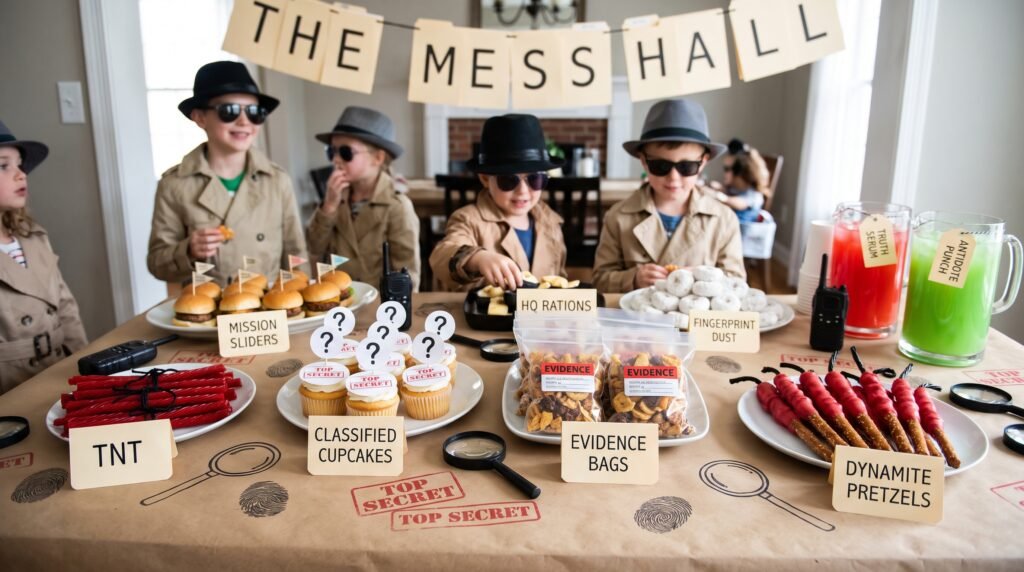
- TNT Licorice Bundles: Bundle three red licorice sticks together and tie them with a piece of black string or a strip of black licorice lace to mimic dynamite sticks.
- Dipped Pretzel Dynamite: Dip extra-large pretzel rods into melted red candy melts, adding a small piece of black pull-apart licorice at the top for a fuse.
- Classified Cupcakes: Frost chocolate cupcakes with clean white swirl frosting and top each with an edible wafer disc stamped “TOP SECRET.”
- Magnifying Glass Sugar Cookies: Bake round butter cookies, cut out the centers before baking, and melt clear hard candies in the middle to create edible “glass” lenses.
- Mustaches on a Stick: Make brownie pops or mustache-shaped sugar cookies mounted on lollipop sticks for an instant edible disguise.
- Secret Agent Slider Packs: Serve mini burger sliders inside individual brown paper burger boxes stamped with red “HQ Rations” markings.
- Poison Antidote Punch: Pour bright lemon-lime soda into a clear punch bowl and top with scoops of lime sherbet for a bubbling, radioactive-green concoction.
- Laser Beam Fruit Skewers: Thread red seedless grapes, strawberries, and raspberries tightly onto bamboo skewers for sleek, healthy “laser” snacks.
- Fingerprint Dusting Powder Donuts: Stack powdered sugar mini donuts high on a platter labeled “Forensic Dusting Powder.”
- Microchip Nacho Bar: Serve triangle tortilla chips alongside a warm slow-cooker crock of queso labeled “Circuit Board Fuel.”
- Red Wire / Blue Wire Licorice Bowls: Set out two matching glass jars filled with red twizzlers and blue raspberry laces labeled “Choose Wisely: Cut the Wire.”
- Declassified Deviled Eggs: Top classic deviled eggs with a dusting of paprika and two sliced black olive pieces arranged into a fedora shape.
- Color-Changing Invisible Ink Lemonade: Brew purple butterfly pea flower tea and freeze it into ice cubes; when poured into clear lemonade, the drink naturally turns bright pink.
- Target Practice Pepperoni Pizzas: Arrange sliced pepperoni on personal pita pizzas into concentric bullseye circles.
- Briefcase Bento Boxes: Pack individual cardboard craft boxes with pinwheel turkey wraps, baby carrots, and pretzels for quick grab-and-go agent field rations.
- Exploding Popcorn: Toss freshly popped butter popcorn with popping Pop Rocks candy and a drizzle of white chocolate for a surprising crunch.
- Laser Beam String Cheese: Wrap individual mozzarella cheese sticks in spiral ribbons of prosciutto or turkey pepperoni.
- Safe Combination Oreos: Use a tube of white decorating icing to pipe numbers around the rim of double-stuffed Oreos like miniature safe dials.
- Listening Device Veggie Cups: Fill the bottom of clear plastic cups with ranch dressing, standing upright celery stalks and carrot sticks inside to look like antennas.
- Undercover S’mores Pops: Dip large marshmallows halfway in melted dark chocolate and roll in crushed graham crackers to hide their identity.
- Spyglass Apple Rings: Core crisp red and green apples, slice them into horizontal rings, and thread them onto salted pretzel sticks for mini looking glasses.
- Smoke Bomb BBQ Meatballs: Keep cocktail meatballs warm in a slow cooker or cast-iron dish surrounded by charred rosemary sprigs for a smoky aroma.
- Edible Decoder Cookies: Ice square cookies in white royal icing and use a red edible marker to draw patterns that reveal hidden letters when viewed through red cellophane.
- Black Tie Pasta Salad: Toss bowtie pasta with black olives, halved cherry tomatoes, and mini mozzarella pearls in a light Italian vinaigrette.
- Truth Serum Mocktail: Mix sparkling apple cider with a splash of cranberry juice, serving it in food-safe plastic test tubes or miniature glass bottles.
- Circuit Board Crispy Treats: Drizzle standard puffed rice cereal squares with thin intersecting lines of lime-green candy melts to mirror motherboard circuitry.
- Trench Coat Pigs-in-a-Blanket: Wrap cocktail sausages snugly in crescent roll triangles with the tops folded over like trench coat collars.
- Counter-Intelligence Caprese Skewers: Skewer cherry tomatoes and mini mozzarella balls, finishing with a dark balsamic glaze drizzle.
- Shaken-Not-Stirred Chocolate Milk: Fill small vintage milk bottles with cold milk and chocolate syrup; provide lids so agents can vigorously shake their own drinks.
- Surveillance Berry Parfaits: Layer dark blackberries, blueberries, and vanilla Greek yogurt into clear shot glasses topped with a single mint leaf.
- Evidence Bag Snack Mix: Seal servings of savory pretzel snack mix into clear ziplock snack bags marked with red sharpie “Item #402: Confidential Evidence.”
- Rolled Turkey Secret Scrolls: Roll deli turkey, cream cheese, and spinach tightly in whole-wheat tortillas and tie each mini roll with a single chive ribbon.
- Bullseye Melon Rounds: Cut thick rounds of seedless watermelon, using round cookie cutters to cut out concentric rings and reassembling them with cantaloupe rings.
- Glowing Kryptonite Gelatin Cups: Make lime-green gelatin cubes in clear cups and set them on top of battery-operated LED tea lights for an eerie glow.
- Gold Bullion Crispy Bars: Cut homemade puffed rice squares into rectangular bars, dip them in yellow-tinted white chocolate, and wrap the bases in clean gold foil candy wrappers.
What safety precautions should I take with spy games involving dark rooms, props, or physical challenges?
For a spy theme party delivery-route activity, the documented setup uses cones, crepe-paper streamers, freestanding chairs, and a foam data cube. The guide says not to tie cords to walls, block exits, or place lines at neck height during that activity. These are specific precautions for the route, not a general safety checklist for every game.
Use fictional agent names rather than asking children to disclose passwords, addresses, private family facts, or real secrets. The ledger doesn’t provide specific dark-room precautions or a general prop-safety checklist, so it doesn’t support claims about how to run those activities safely. A spy theme party host should not treat the listed route guidance as covering unaddressed situations. The documented materials and limits are narrow: the route activity and protecting private information are addressed, while other safety details remain unknown.
Which spy-themed party supplies can I reuse, and which are usually single-use?
The sources identify supplies used in spy theme party activities, but don’t say which are reusable or single-use. One activity bag contained a graph cipher, peek-a-boo cipher, mason cipher, and an empty toilet-paper tube. A sensory-box activity used a large cardboard box with two hand holes, while a disguise relay used costume props such as hats, sunglasses, and mustaches.
Those descriptions tell you what the activities used, not how long the items last or whether they can be used again. The reuse answer is therefore unresolved: the ledger doesn’t classify cipher materials, costume props, or the cardboard box as reusable or disposable. For a spy theme party, don’t assume that a supply is single-use—or reusable—based only on its appearance or the activity description. There’s also no source-backed count of how many replacement items a host should plan to buy.
Where can I buy or book spy-themed party decorations, kits, or entertainment?
The listed purchase option for a spy theme party is a printable Secret Agent treasure hunt priced at $13.99 and delivered instantly by email after ordering. The source also says costume props for a disguise relay—hats, sunglasses, and mustaches—may be found at dollar stores, thrift stores, or in a basement.
The ledger doesn’t identify where to buy decorations or complete party kits, and it provides no booking options for entertainers. It also doesn’t establish that the printable purchase includes physical supplies or entertainment. For a lower-stress plan, use the documented printable or activity materials as options, while treating the sourcing of everything else as unknown. A spy theme party host would need additional information to compare complete kits, decoration sellers, or entertainment bookings; no such options or prices are supplied here.Spy-party activities and stated materials or setup (compiled from 3 sources)
| Activity | Stated materials or setup |
|---|---|
| The laser challenge | yarn and mini bells, or party streamers, with the yarn crossed so players crawl… |
| The fingerprint game | one index card per player, cut in half, with matching prints made on each card… |
| The sensory box | a large cardboard box with two holes cut large enough for children to put their… |
| The supervised delivery-route activity | cones, crepe-paper streamers, freestanding chairs, and a foam data cube |
Key Takeaways
- Build the activity flow around spy training followed by a cooperative mission.
- Use the documented activity quantities as starting points, not as a complete shopping list.
- Treat $13.99 as the listed printable activity price, not a full-event budget.
- Keep the mission cooperative and use the specific safety guidance provided for the delivery route.
- Package contents, reuse status, full costs, and booking options remain unknown where the ledger doesn’t specify them.
Frequently Asked Questions
How much does a spy-themed party cost?
The listed printable Secret Agent treasure hunt costs $13.99 and is delivered by email after ordering. The ledger doesn’t provide a total budget for a party or prices for other supplies.
Are spy party packages different for children, teens, and adults?
The printable mystery detective game is described as suitable for ages 8–14, with ten challenges and five suspects. The ledger doesn’t give specific package recommendations for teens or adults.
How can I make spy games safer?
For the documented delivery-route activity, don’t tie cords to walls, block exits, or place lines at neck height. The ledger doesn’t give general dark-room or prop-safety instructions.
Which spy party supplies can I reuse?
The sources list supplies used in activities but don’t say which are reusable or single-use. Their reuse status remains unknown.